
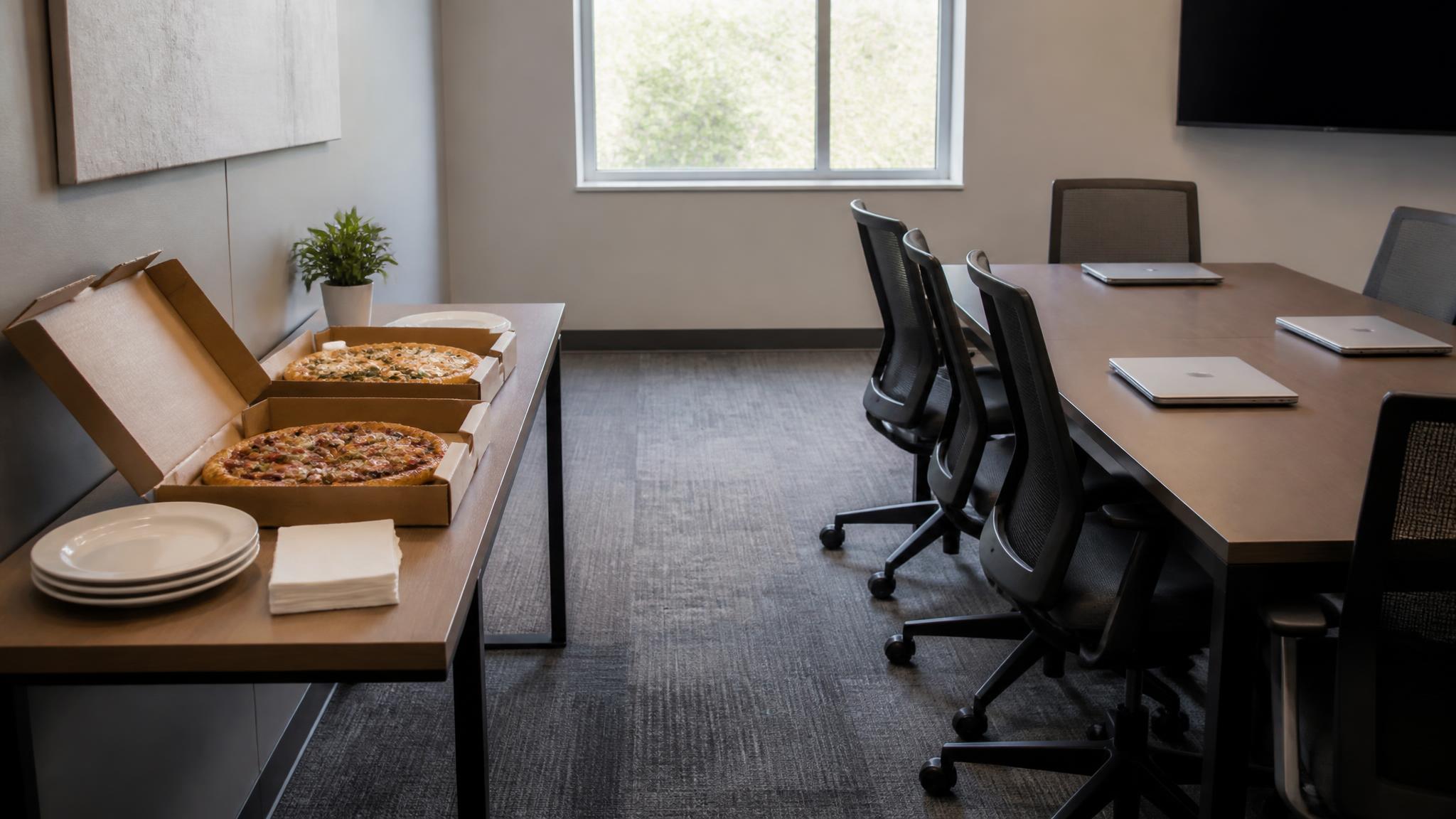
A pizza buffet in a small meeting room needs a workable serving route, not simply an empty table. Before deciding where the food will go, picture someone leaving their chair, collecting a plate, choosing pizza and returning to their seat while another person does the same. For an office gathering in E16, that simple exercise can help you choose between a self-service table, a managed serving point or a different space altogether.
This guide focuses on what happens inside the room: where to put things, how to avoid awkward crossing points and how to keep the space usable throughout lunch.
Start with the room as it will actually be used
Look at the room with chairs occupied or pulled out to their likely positions. A clear-looking gap behind tucked-in chairs may disappear once the meeting starts. Include laptop bags, coats, presentation equipment and anything else that will remain during lunch.
- Trace the route from each seating area to the proposed buffet and back.
- Check whether an open door, cupboard or pizza-box lid would obstruct that route.
- Keep doorways and designated exit routes clear; ask the workplace contact about any restrictions on moving furniture.
- Ask attendees privately about access or serving assistance they would find helpful rather than assuming everyone can stand, reach or carry a plate.
Do not infer a room’s permitted capacity from how many chairs or pizza boxes fit. If the layout seems workable only when people squeeze past one another, change the serving arrangement or ask about another suitable space.
Choose a serving arrangement that fits the room
These are hypothetical layout options, not assessments of any particular venue. Choose according to the room’s actual furniture and available routes.
| Arrangement | When to consider it | What to check |
|---|---|---|
| Buffet along one wall | A side table is available without displacing essential equipment. | People can approach and leave without trapping seated colleagues behind the queue. |
| Serving at one end of the meeting table | The table end can be cleared and lunch can pause the meeting. | Open boxes will not cover working space or make people reach across laptops and drinks. |
| Host-assisted serving | Repeated trips to a buffet would be awkward. | A willing host has a clear serving position and can check each person’s choice before passing food. |
| Separate approved eating space | No layout leaves a practical route through the meeting room. | The workplace contact agrees to its use and attendees can access it comfortably. |
A central buffet is not automatically an improvement. In a hypothetical room with chairs on every side, it could create several competing approaches. Test the route before treating access from all sides as an advantage.
Plan the table with boxes open
Ask about the expected packaging dimensions, then mark out its footprint using paper or empty packaging. Allow for lids in their intended position, plates, napkins, any serving utensils and readable dish information. Do not assume every box needs to be open on the table at once.
Arrange the serving sequence so people can take a plate before choosing food, without returning against the flow. Put napkins within easy reach. If a separate drinks position is practical, consider it so pouring a drink does not hold up pizza selection; avoid creating a second queue across the first.
If everything cannot fit, ask whether a smaller initial display and host-managed replenishment would be workable. Confirm any holding and serving instructions with the supplier rather than improvising storage arrangements.
Make choices clear before people reach the food
Give attendees an opportunity to share dietary requirements before lunch. At the buffet, keep dish information beside the corresponding food and avoid moving boxes without moving their information too. Where utensils are provided, keep them with their intended dish rather than passing one between choices.
Zzetta offers Halal, Vegan and Gluten-Free options from one flame-fired kitchen. Discuss specific ingredients and suitability with staff. Separate positions, labels or utensils must not be presented as proof that food is allergen-safe, free from cross-contamination or suitable for someone with coeliac disease.
Ask staff how to identify each confirmed choice. A colleague helping with service should pass on confirmed information, not guess from a pizza’s appearance.
Manage movement without turning lunch into a queue
Before serving begins, explain where people should start and where they can return to their seats. If the room would become congested with everyone standing, invite people to collect food in small groups based on what the route can comfortably accommodate. Offer assistance without making someone explain their needs publicly.
Keep a separate clearing point away from the food where possible. Decide who will remove empty packaging and check the route during lunch. Avoid balancing used plates on unopened boxes or letting bags accumulate beside the buffet.
Turn your layout plan into an enquiry
Zzetta is an independent stone-oven pizzeria, established in 2018, on Barking Road in Canning Town. Use the menu to frame questions about choices, and the Catering Hub for your catering enquiry. Confirm arrangements directly rather than assuming equipment or serving assistance is included.
Suggested enquiry: “We’re planning a pizza buffet for [number] people in an E16 meeting room on [date]. Our proposed serving surface measures [dimensions], with [layout description]. Please advise on packaging footprint, identifying dietary choices, any serving equipment available and relevant serving instructions. Our dietary requirements are [details]. Could you provide a quote?”
Get a Quote on WhatsApp with your room-layout notes and requirements.
Zzetta – Soul Fired Pizza · 110 Barking Road, Canning Town, London E16 1EN · 020 3904 7074 · WhatsApp +44 7852 272312 · ciao@zzetta.co.uk