
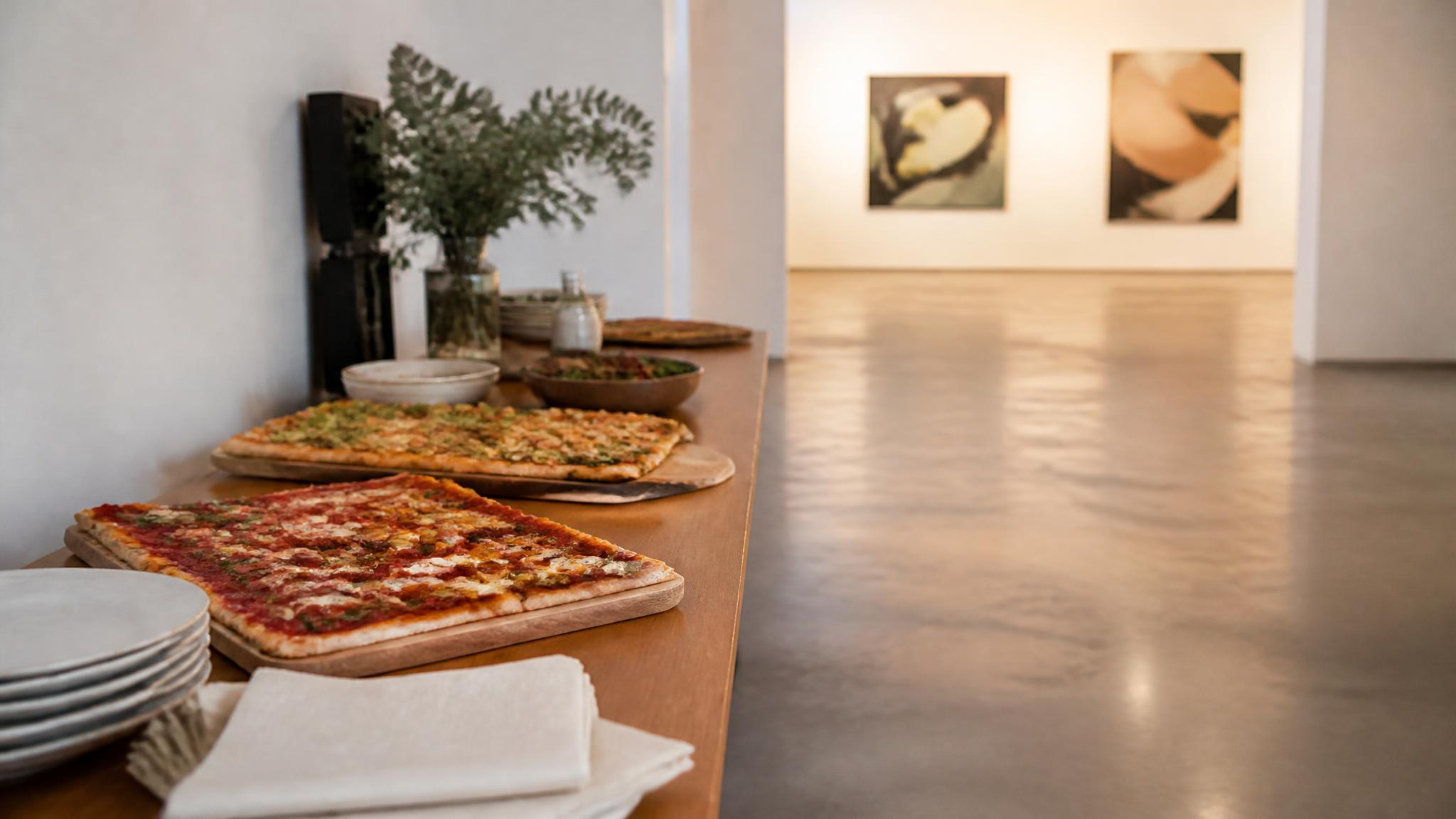
At a gallery opening, the exhibition should remain the reason people move through the room. Plan pizza service around that experience: where guests arrive, where they pause to look, and where they can comfortably stop to eat. For an opening in the Royal Docks or elsewhere in East London, the first decision is not how many food stations to create. It is which parts of the venue can accommodate food without competing with the artwork.
Start with a simple floor plan and the gallery’s permission. Then choose a serving format that fits the space, rather than rearranging the exhibition around a buffet.
Map three guest journeys before placing the food
Draw the entrance, reception point, exhibition route, toilets and any agreed speaking area. Add door swings, narrow passages and access routes that the venue needs kept clear. Ask the gallery to mark where food, drinks, serving furniture and waste collection are permitted.
Now trace three hypothetical journeys:
- The new arrival: entering, checking in, leaving a coat if facilities are available, and finding the first work to view.
- The browsing guest: moving between artworks, stepping back to look and joining conversations.
- The eating guest: collecting food, finding an agreed place to pause and disposing of a plate before returning to the exhibition.
Where those routes overlap, consider moving the serving point or changing the format. Avoid making guests queue across the entrance or stand in the viewing space in front of a work. Ask the venue to review the proposed layout for access and artwork protection; do not assume an apparently empty corner is available.
Choose the serving format by the room’s constraints
Use this comparison to select a proposal for the gallery and caterer. These are planning options, not confirmed services or equipment supplied by Zzetta.
| Proposed format | When to consider it | What to resolve first |
|---|---|---|
| One fixed collection point | A separate foyer or permitted social area can hold the queue and people eating. | Where the queue ends, who replenishes food and whether guests can leave without crossing those waiting. |
| Small batches at a fixed point | You want food service to fit around a welcome speech or a particular viewing period. | Who releases each batch and how the collection area will be managed between servings. |
| Hosted tray service | You want to avoid a central queue and the venue permits food within the relevant rooms. | Whether suitable staffing, trays and clear circulation routes can be arranged. |
| Two collection points | Separate permitted areas would otherwise send everyone towards one bottleneck. | Whether both points can be supervised, replenished and clearly labelled without confusing guests. |
For a hypothetical single-room opening with a narrow entrance, propose one food point away from the doorway, with an agreed eating area beside it. For a hypothetical exhibition with a separate foyer, consider keeping food there and inviting guests to return to the artwork after eating. Neither arrangement should be adopted without the venue’s agreement.
Design the collection point from both sides
Sketch what the guest sees and what the person replenishing food needs. Put menu information before the collection position so guests can consider their choice without holding a plate over the serving area. Discuss where plates and napkins belong, and leave an obvious way to step aside after collecting.
Ask whether pizza can be supplied in a serving size appropriate to standing guests, rather than assuming a particular cut or presentation. Establish who supplies serving utensils, furniture and waste containers. Position waste collection where the gallery approves it, without drawing people across the queue or towards artworks.
Decide where reserve food and empty packaging will go. A service plan is incomplete if replenishment requires boxes to be carried through a tightly gathered audience.
Give viewing, speeches and eating separate attention
Mark the welcome speech or artist introduction on your proposed running order. Decide whether collection will pause, continue elsewhere or begin afterwards. Tell whoever manages service which arrangement has been agreed, and keep the speaking area separate from the queue.
If arrivals are staggered, discuss a phased serving plan rather than assuming everyone will eat together. Ask the caterer what is feasible and what handling arrangements are needed. Nominate an organiser to manage timing so the artist or gallery host does not have to leave conversations to direct food service.
Make dietary questions easy to ask
Zzetta is an independent stone-oven pizzeria established in 2018, offering Halal, Vegan and Gluten-Free options from one flame-fired kitchen. Specific ingredients and suitability must be discussed with staff; those options are not a promise of allergen-safe preparation or zero cross-contamination.
Review the Zzetta menu as a starting point for questions. Agree how confirmed choices will be identified at the serving point and who will answer ingredient queries. Do not let guests infer suitability from appearance or placement alone.
Get a quote built around your exhibition
Visit the Catering Hub to Get a Quote, or send a WhatsApp enquiry with this outline:
“We’re planning a gallery opening at [venue/address] on [date], with approximately [guest count] guests. Food is permitted in [area]. Our proposed format is [format], with service around [viewing/speech timing]. The main layout constraint is [doorway, circulation route or separate room]. We need to discuss [dietary requirements] and confirm what food, staffing and equipment arrangements are possible. Could you quote against this plan?”
Zzetta – Soul Fired Pizza · 110 Barking Road, Canning Town, London E16 1EN · 020 3904 7074 · WhatsApp +44 7852 272312 · ciao@zzetta.co.uk