
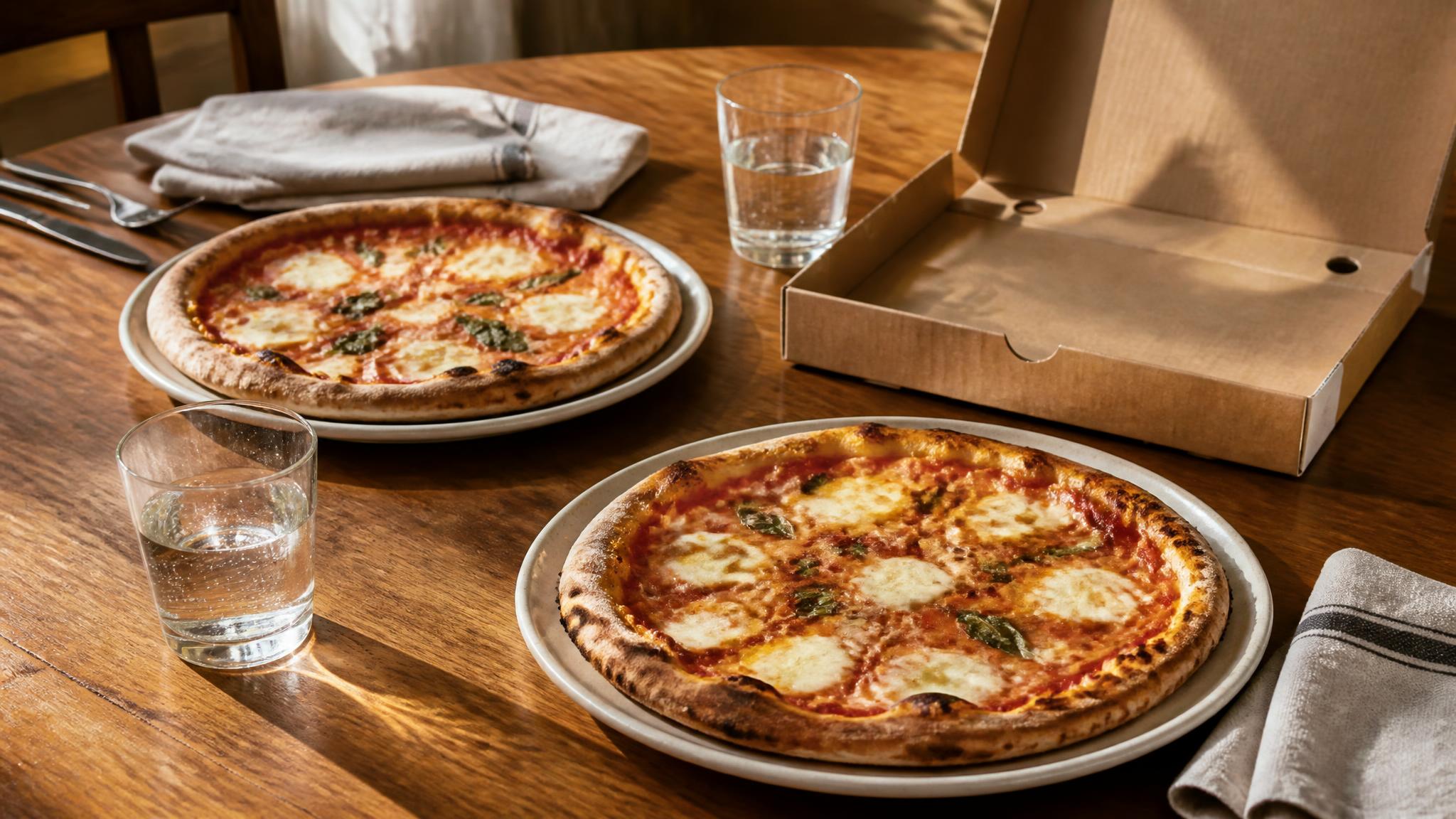
Choosing between eating at a restaurant and collecting pizza is really a choice about where you want the occasion to happen — and who will do the hosting. For plans around Canning Town or the Royal Docks, start with the experience your group needs, rather than assuming one format will be easier for everyone.
Zzetta is an independent stone-oven pizzeria, established in 2018, at 110 Barking Road, Canning Town. This guide helps you decide which arrangement to enquire about; it does not confirm seating or collection availability for any particular date.
The quick comparison
| Your priority | Dine-in enquiry | Collection enquiry |
|---|---|---|
| Spend time together without hosting at home | A stronger starting point if the meal itself is the occasion. | Less helpful unless someone already wants to host. |
| Keep an activity in your chosen space | Means moving the gathering to the restaurant. | A stronger starting point for a meal alongside that activity. |
| Reduce organiser responsibilities | Avoids setting up and clearing a separate eating space. | Leaves collection, serving and clearing with your group. |
| Accommodate different arrival patterns | Ask how the proposed group arrangement would work. | Decide whether everyone can gather around an agreed mealtime. |
| Discuss individual food requirements | Ask what can be clarified before the visit and when ordering. | Resolve requirements before confirming the order and handover arrangements. |
Choose dine-in when the meal is the main event
A restaurant enquiry makes sense when your aim is to meet, talk and eat without turning somebody’s home or workplace into the venue. It may suit a catch-up, a small celebration or a meal after a shared activity, provided the proposed arrangements work for the group.
For example, imagine a hypothetical group of friends meeting after work. Nobody wants to host, and there is no activity they need to return to. Dine-in is the more natural option to explore: moving pizza elsewhere would add a collector and a host without supporting the purpose of the evening.
The organiser’s job is then to establish whether the setting fits. Explain the group size, preferred date and time, and anything that materially affects the visit. If step-free access, seating arrangements or room for a pushchair matters, ask specifically rather than inferring those details from an address.
If you have another commitment afterwards, mention it before agreeing arrangements. Ask whether your intended meal window is realistic; do not treat a requested arrival or departure time as a confirmed service promise.
Choose collection when the setting matters more
Collection is worth exploring when you already have a suitable place to eat and a reason to stay there. The key advantage is preserving the gathering’s setting, not an assumed saving in time or cost.
Consider a hypothetical games evening at a friend’s flat in the Royal Docks. The table is ready, the host is happy to clear up, and the group wants to continue playing. Collection could fit that occasion better than relocating everyone for dinner, subject to confirming the order and collection arrangements.
However, collection does not remove hosting work; it assigns it to your group. Someone needs to collect and carry the order, while someone prepares the eating space. Decide whether those can sensibly be different people so the host is not also absent when guests arrive.
For a workplace, hired room or shared building, check permission to bring in outside food before making plans. Also establish where people will eat and who will clear away. If those answers are uncertain, dine-in may be the simpler option to investigate.
Make the organiser’s workload visible
Before choosing, ask the group one useful question: “Are we meeting for a meal, or adding a meal to something we already want to do?” The first points towards a dine-in enquiry; the second towards collection.
Then test that preference against three responsibilities:
- The gathering: who brings everyone together at the agreed place and time?
- The food decisions: who gathers preferences and checks individual requirements with staff?
- The hosting: who provides the space, serves the food and deals with clearing up if you collect?
This is not a delivery checklist. The decision comes before order logistics: choose the format that puts the least unwanted work on the people organising the occasion.
Discuss dietary requirements before choosing the format
Zzetta offers Halal, Vegan and Gluten-Free options simultaneously from one flame-fired kitchen. That does not establish the suitability of every dish for every guest. Discuss specific ingredients and individual requirements with staff before confirming plans; do not assume allergen-safe preparation or zero cross-contamination.
You can use the menu as a starting point for questions, rather than treating a dish name as a complete suitability check. Neither dining in nor collecting replaces that conversation.
Send an enquiry that explains the occasion
For a team or organised group, the Catering Hub is a useful enquiry starting point. For a social visit, explain the restaurant arrangements you would like to discuss.
“Hello, I’m arranging [occasion] for approximately [number] people on [date], around [time]. We are considering [dining in / collection] because [reason]. Our group needs to discuss [requirements]. Could you confirm whether this arrangement is possible, what information you need and the relevant costs before we decide?”
Get a Quote on WhatsApp, making clear whether you want to discuss a restaurant visit or collection. Treat the enquiry as the start of a conversation, not a confirmed booking or order.
Zzetta – Soul Fired Pizza · 110 Barking Road, Canning Town, London E16 1EN · 020 3904 7074 · WhatsApp +44 7852 272312 · ciao@zzetta.co.uk