
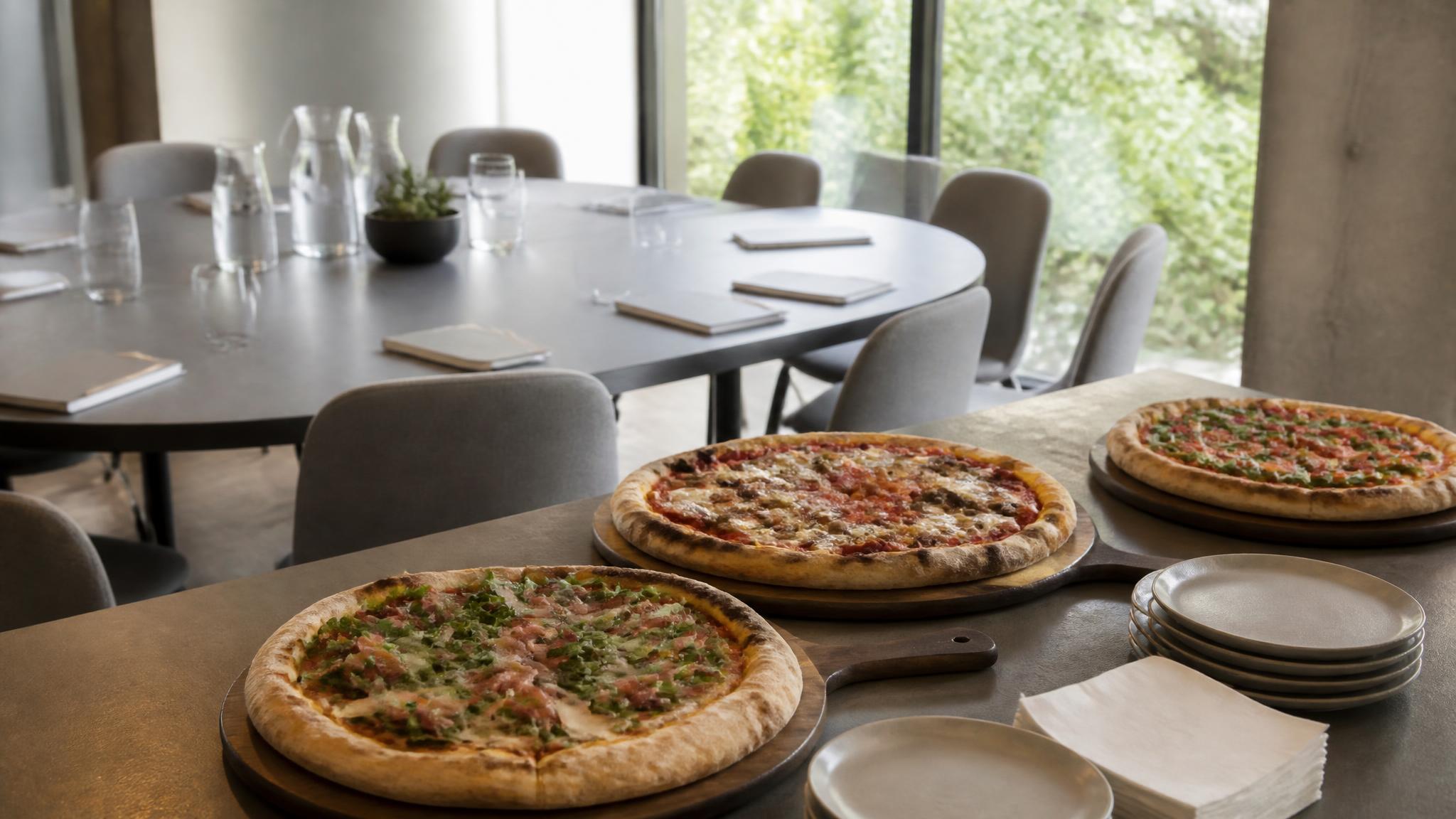
A client workshop lunch has two jobs: give everyone a proper opportunity to eat and protect the discussion you have brought them together to have. Those jobs do not always fit into the same half-hour. Before choosing food for a workshop in Canary Wharf or Canning Town, decide whether lunch is a genuine break, an informal conversation or part of the working session.
A useful default is to pause for serving and eating, then restart with a light discussion before returning to decisions. If your agenda cannot accommodate that, adapt the task rather than expecting guests to juggle food, laptops and a demanding exercise. Here is how to choose a format that fits.
Start with the work immediately around lunch
Look at the agenda items on either side of the proposed lunch slot. Are participants listening, sketching, negotiating or approving a recommendation? Treat those as different situations.
- After a demanding exercise: protect a break rather than adding another task to lunch.
- Before a major decision: allow people to finish eating and return to the same information before asking for agreement.
- During relationship-building: offer an optional conversation prompt, without turning every mouthful into workshop participation.
- During hands-on work: separate food from the exercise, particularly where guests need keyboards, paper layouts or shared materials.
Ask the client sponsor one direct question: “What must we achieve before lunch, and what can wait until everyone is ready to restart?” That answer is more useful than simply labelling the slot a working lunch.
Compare three ways to serve lunch
| Format | Agenda fit | Trade-off to manage |
|---|---|---|
| Separate serving point and a protected break | A clear pause between substantial workshop blocks | Requires space away from working materials and an explicit restart time |
| Shared food at a cleared table | Informal conversation where nobody needs to write or present | Passing food and reaching across the table can interrupt discussion; seating needs thought |
| Individual portions, if agreed with the provider | A seated lunch where limiting shared handling is a priority | Portioning, identification and what is included must be confirmed rather than assumed |
For pizza, decide whether guests will collect food and sit elsewhere or eat at the workshop table. Do not assume that shared food requires shared boxes among laptops. A separate collection point may suit your room better, provided everyone can use it comfortably.
Individual portions are a possible arrangement to ask about, not a confirmed Zzetta service. Likewise, check any requested serving equipment or labelling before building the session around it.
Give serving its own place in the agenda
“Lunch and discussion” leaves several unanswered questions: when do people collect food, who keeps talking, and when is everyone expected to contribute? Write those transitions into the facilitator’s plan.
The following is a hypothetical workshop sequence, not a service timetable:
- 12.15–12.20: capture the morning’s conclusions and explain the next session.
- 12.20–12.35: pause formal work for serving and eating, with no new instructions.
- 12.35–12.50: allow optional informal conversation while people finish lunch.
- 12.50–13.00: clear the working area, offer a short personal break and bring everyone back together.
- 13.00: recap the next task before restarting facilitated work.
Adjust the allocations for your group and room. If the lunch window is shorter, remove the informal discussion before removing the opportunity to eat. Agree beforehand which non-essential exercise can move if the morning overruns.
Keep lunch conversation separate from client approval
If you want a conversation prompt, make it easy to answer without notes: “Which idea from this morning would you like us to explore further?” Avoid introducing a new brief while some guests are still collecting food.
Appoint a facilitator to note questions worth revisiting, but do not treat a lunchtime remark as formal approval. Bring proposals back into the main session so everyone can hear, challenge and confirm them. Guests should also be free to take a quiet break rather than having to remain visibly productive throughout lunch.
Make dietary requirements part of the format decision
Collect requirements privately before choosing how food will be shared. Ask what each guest needs you to discuss with the restaurant, rather than asking them to explain it across the client table.
Zzetta offers Halal, Vegan and Gluten-Free options from one flame-fired kitchen. Specific ingredients and suitability must be discussed with staff; these options do not establish allergen safety, absence of cross-contamination or suitability for coeliac disease.
Ask how the agreed choices would be identified and presented. Do not rely on appearance or assume a separate plate resolves an ingredient or preparation concern. Confirm arrangements before promising guests that their requirements can be met.
Send an enquiry that explains the workshop
Zzetta is an independent stone-oven pizzeria established in 2018 in Canning Town. Browse the menu to frame your questions, then use this enquiry template:
“We are planning a client workshop in [Canary Wharf/Canning Town] on [date] for [number] people. Lunch sits between [morning activity] and [afternoon activity]. We would prefer [serving format], with a protected eating break of [duration]. Dietary requirements to discuss are [details]. Could you confirm what arrangements are possible, how choices would be identified and what serving items would be included? Please provide a quote.”
Get a Quote: visit the Catering Hub or send your workshop outline by WhatsApp. Confirm the proposed arrangements before finalising the client agenda.
Zzetta – Soul Fired Pizza · 110 Barking Road, Canning Town, London E16 1EN · 020 3904 7074 · WhatsApp +44 7852 272312 · ciao@zzetta.co.uk